
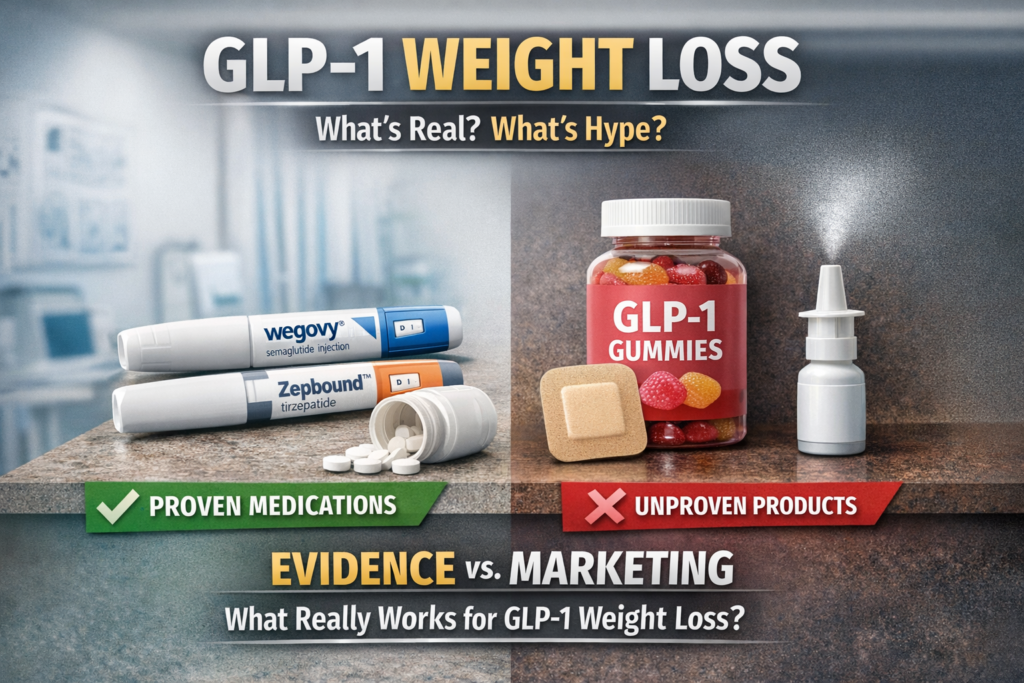
GLP-1 Weight Loss: A Clear Guide to the Options, the Evidence, and the Claims
If you’ve been seeing headlines, ads, or social media posts about GLP-1 weight-loss drugs, you’re not imagining things — these treatments are everywhere right now. For some people, prescription medications like Wegovy and Zepbound have been genuinely life-changing. For others, the explosion of “GLP-1 gummies,” patches, sprays, and drops has created more confusion than clarity.
Sustainable weight loss is less about willpower and more about how your body regulates energy, hormones, and habits. Let’s walk through what actually works—and why.
Many people reading this are trying to make a thoughtful decision about their health — not chase trends or shortcuts.
It’s completely reasonable to ask:
What’s actually real? What really works? And what’s just clever marketing?
This guide was created to help answer those questions clearly. Below, you’ll find an evidence-based overview of all the GLP-1 delivery options currently being talked about, how they work in the body, how effective they truly are, and which ones are supported by solid medical research and regulatory approval.
This content is based on peer-reviewed clinical trials, U.S. Food and Drug Administration (FDA) safety communications, and prescribing information from approved GLP-1 medications. It is intended for educational purposes and does not replace personalized medical advice from a licensed healthcare professional.
Why GLP-1 Weight-Loss Treatments Are Getting So Much Attention
Interest in GLP-1 medications has surged as obesity rates remain high and newer drugs demonstrate unprecedented levels of weight loss in clinical trials. At the same time, supply shortages, high demand, and viral social media content have contributed to a rise in unregulated products marketed as GLP-1 alternatives.
This combination has made it more important than ever to understand which options are **safe, effective, and evidence-based**, and which ones rely primarily on marketing rather than medicine.
What GLP-1 Medications Actually Do in the Body
GLP-1 (glucagon-like peptide-1) is a hormone your body naturally releases after you eat. Its role is to help regulate appetite and metabolism. When GLP-1 is active, it supports weight control by:
– Sending “fullness” signals to the brain
– Reducing hunger and food cravings
– Slowing how quickly food leaves the stomach
– Supporting healthier blood-sugar regulation
Prescription GLP-1 medications are designed to **strengthen this natural process**, not override it. Over time, many people notice they eat less and feel satisfied sooner — not because of increased willpower, but because appetite signals change at a biological level.
This mechanism explains why GLP-1 treatments have become such an important tool in modern medical weight-loss care.
It’s also important to understand that **all legitimate GLP-1 medications work through the same basic biological pathway**. What differs between options is:
– The **active drug molecule** (such as semaglutide, tirzepatide, or liraglutide)
– The **delivery method** (injection versus pill)
– How strong, long-lasting, and consistent the appetite-suppressing effect is
These differences matter when comparing results — and when evaluating claims.
Proven GLP-1 Weight-Loss Treatments (Prescription Medications)
Prescription GLP-1 medications are the only treatments in this category supported by large randomized clinical trials and regulatory approval. They have been studied in thousands of people with overweight or obesity and consistently show meaningful, sustained weight loss when used under medical supervision.
Weekly Injectable GLP-1 Medications
Weekly injectable GLP-1 treatments are currently considered the most effective and most thoroughly studied options available.
– Wegovy (semaglutide)
In large clinical trials, participants lost an average of about 15% of their body weight over roughly one year when semaglutide was combined with lifestyle support.
– Zepbound (tirzepatide)
Tirzepatide works on two metabolic pathways (GLP-1 and GIP)** rather than one. In studies, participants lost 20% or more of their body weight on average, making it the most potent GLP-1-based treatment currently approved for obesity.
These medications tend to work so well because they deliver a consistent dose directly into the bloodstream, leading to steady appetite suppression and convenient once-weekly dosing.
Daily Injectable GLP-1 (Older Generation)
Saxenda (liraglutide)
Saxenda was one of the first GLP-1 medications approved specifically for weight loss. It is effective, but for many people the results are more modest than with newer treatments. Because it requires daily injections, maintaining long-term consistency can be more challenging.
Oral GLP-1 Pills (Prescription Only)
Prescription oral semaglutide is now available as a pill for weight management.
- Uses the same active ingredient as injectable semaglutide
- Taken once daily
- Must be taken on an empty stomach with careful timing
Clinical studies show mid-teens percentage weight loss, though real-world effectiveness depends heavily on adherence. For people who strongly prefer avoiding injections, oral GLP-1 medication can be a reasonable, medically legitimate option.
GLP-1 Products That Are Not Proven
Alongside prescription medications, many non-prescription products are marketed using the term “GLP-1.” This is where confusion often begins.
GLP-1 Gummies
There are no FDA-approved GLP-1 gummy medications for weight loss. Products sold as “GLP-1 gummies” are typically dietary supplements and do not contain regulated semaglutide or tirzepatide.
While some may include fiber or botanical ingredients, they are not equivalent to prescription GLP-1 drugs, and their weight-loss claims are not supported by high-quality clinical evidence.
GLP-1 Patches
There are currently no approved GLP-1 patches for weight loss.
From a scientific perspective, this matters because GLP-1 medications are large peptide molecules that are extremely difficult to absorb through the skin in a consistent, controlled way. Any true GLP-1 patch would require extensive human trials — and those data do not exist at this time.
Sprays, Drops, and “Research Peptides”
Some online sellers advertise GLP-1 products as sublingual drops, nasal sprays, or “for research use only” peptides.
Regulatory agencies have issued repeated warnings about these products due to concerns including incorrect dosing, contamination, counterfeit labeling, and misleading marketing. These products should not be considered safe or equivalent alternatives to prescription medications.
Comparison Table: GLP-1 Weight-Loss Options
| Delivery Method | Prescription Required | Average Weight Loss | Evidence Strength |
|---|---|---|---|
| Weekly injection (tirzepatide) | Yes | ~20%+ | Very strong |
| Weekly injection (semaglutide) | Yes | ~15% | Very strong |
| Oral GLP-1 pill | Yes | ~14–17% | Strong |
| Daily injection (liraglutide) | Yes | ~8–10% | Moderate |
| Gummies / patches / sprays | No | Unproven | Weak |
Questions People Commonly Ask About GLP-1 Weight Loss
Are GLP-1 gummies effective for weight loss?
No. There is no reliable clinical evidence showing that gummies can deliver therapeutic GLP-1 medication or produce results comparable to prescription drugs.
Which GLP-1 option is most effective?
Current evidence shows that weekly injectable tirzepatide produces the greatest average weight loss, followed closely by injectable semaglutide.
Are oral GLP-1 pills as effective as injections?
They can be effective, but they require strict daily dosing conditions. Injections generally provide more consistent absorption and are easier for many people to maintain long term.
Will weight return after stopping GLP-1 medication?
Many people experience some degree of weight regain after stopping treatment, as appetite regulation shifts back toward baseline. Long-term success often involves ongoing treatment, lifestyle changes, or both.
References
U.S. Food & Drug Administration (FDA). FDA’s concerns with unapproved GLP-1 drugs used for weight loss.
Wilding JPH et al. Once-Weekly Semaglutide in Adults with Overweight or Obesity.
New England Journal of Medicine, 2021.
Jastreboff AM et al. Tirzepatide Once Weekly for the Treatment of Obesity.
New England Journal of Medicine, 2022.
Novo Nordisk. Wegovy® (semaglutide) Prescribing Information.
National Institutes of Health (NIH). GLP-1 receptor agonists: mechanism of action.
FDA Warning Letters and Safety Alerts on Compounded and Counterfeit GLP-1 Products (2023–2025).
Last Updated: January 2026
We’ve prepared an up-to-date comparison of leading GLP-1 weight-loss providers, reviewed for safety, availability, and care model
All GLP-1 medications require a prescription and medical supervision.
Information is for educational purposes only and is not medical advice.

 DISCLAIMER